publications
* denotes equal contribution.
2026
- AIKN Iyengar*, Tampu Ravi Kumar*, Gaurav Najpande, Manan Suri, Dinesh Manocha, Puneet Mathur, and Vivek GuptaIn Advances in Neural Information Processing Systems (NeurIPS), 2026
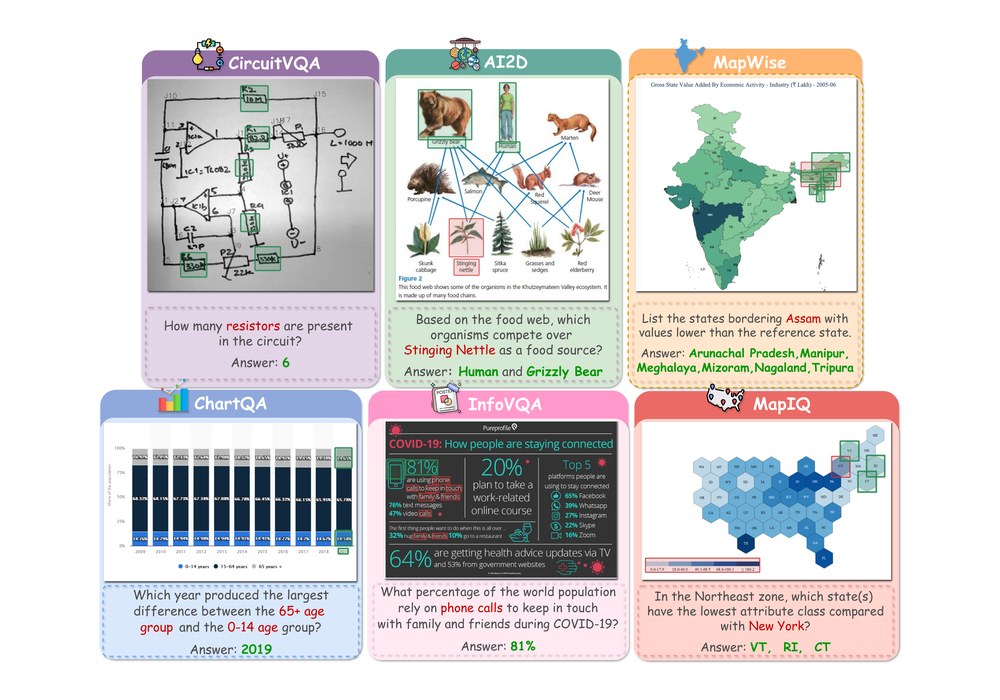
Diagram question answering (DQA) requires models to interpret structured visual representations such as charts, maps, infographics, circuit schematics, and scientific diagrams. Recent vision-language models (VLMs) often achieve high answer accuracy on these tasks, yet correct answers do not guarantee that models ground their reasoning in the diagram regions that support the prediction. Models may instead rely on textual correlations or dataset artifacts without identifying the visual evidence required to verify the answer. This limitation prevents reliable evaluation of diagram reasoning and reduces interpretability. We introduce DRAGON, a benchmark for evaluating evidence-grounded visual reasoning in diagrams. Given a diagram, a question, and the correct answer, a model must predict bounding boxes that correspond to the visual elements required to justify the answer. These evidence regions may include answer-bearing components, textual labels, legends, axes, connectors, and other supporting structures involved in the reasoning process. The DRAGON dataset contains 11,664 annotated question instances from six diagram QA datasets: ChartQA, Circuit-VQA, InfographicsVQA, MapIQ, MapWise, and AI2D, with a 2,445-instance test set carrying human-verified evidence annotations and a standardized evaluation framework. Our evaluation on recent VLMs reveals that even Claude Opus 4.6 achieves a Grounding IoU of only 23.8% on AI2D, showing that faithful visual grounding remains an open challenge. DRAGON supports future research on models that ground their predictions in visual evidence.
- Tampu Ravi Kumar, Gaurav Najpande, Muhammad Ali Khan, Kaneez Zahra Rubab Khakwani, Karan Kathuria, Shorya Azriel Moses, Yuvraj Kalia, M Bassam Sonbol, Irbaz Bin Riaz, and Vivek GuptaIn Proceedings of EMNLP: System Demonstrations, 2026
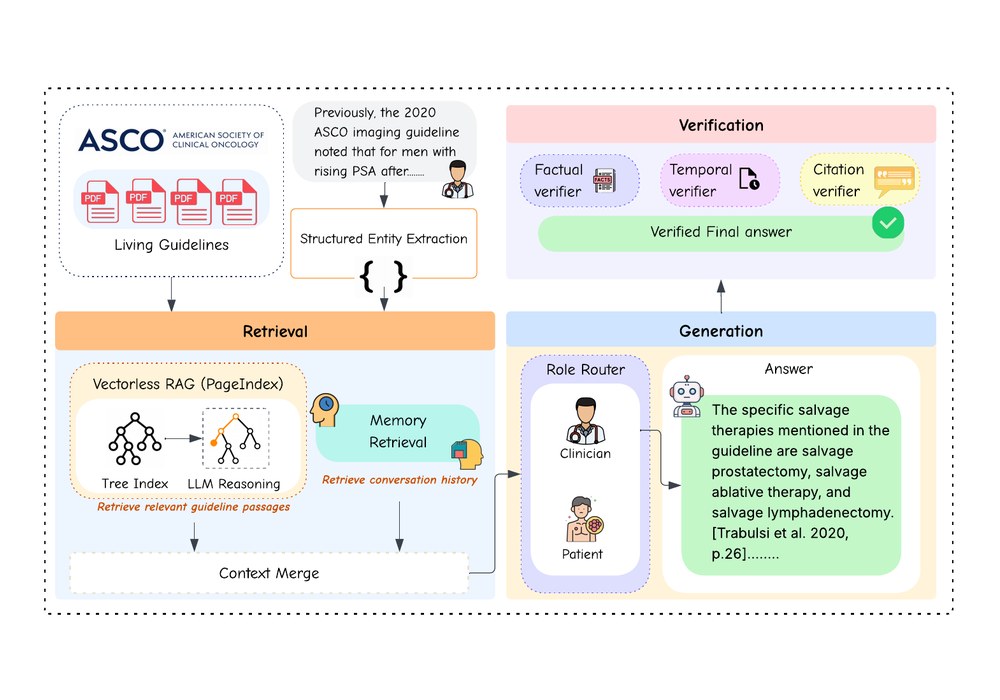
Oncology care operates at constant pressure of absorbing rapidly evolving evidence base in biomedicine. The American Society of Clinical Oncology (ASCO) addresses this through living guidelines, but the format introduces a new burden: any recommendation can change at any point, across multiple versioned documents. We present SENTRYLINE, a living guideline-aware clinical question answering system. SENTRYLINE retrieves guideline passages through a vectorless hierarchical RAG pipeline and returns a role-specific answer with inline citations, factual and temporal verification reports, and drift detection notes that surface when a guideline has been updated. We construct ASCOBENCH, a benchmark of 405 three-turn conversations across four question categories with gold answers from expert annotators(clinicians), and use test set to evaluate SENTRYLINE against five baselines under an LLM-as-judge framework. Experiments across three generation backbones show consistent improvements over four retrieval baselines and ASCO’s guideline assistant, with particularly strong gains on Reasoning and Role-Specific questions where multi-hop synthesis and register adaptation are required
- Gaurav Najpande, Tampu Ravi Kumar*, Manan Roy Choudhury*, Neha Valeti*, Yanjie Fu, and Vivek GuptaIn Findings of EMNLP, 2026
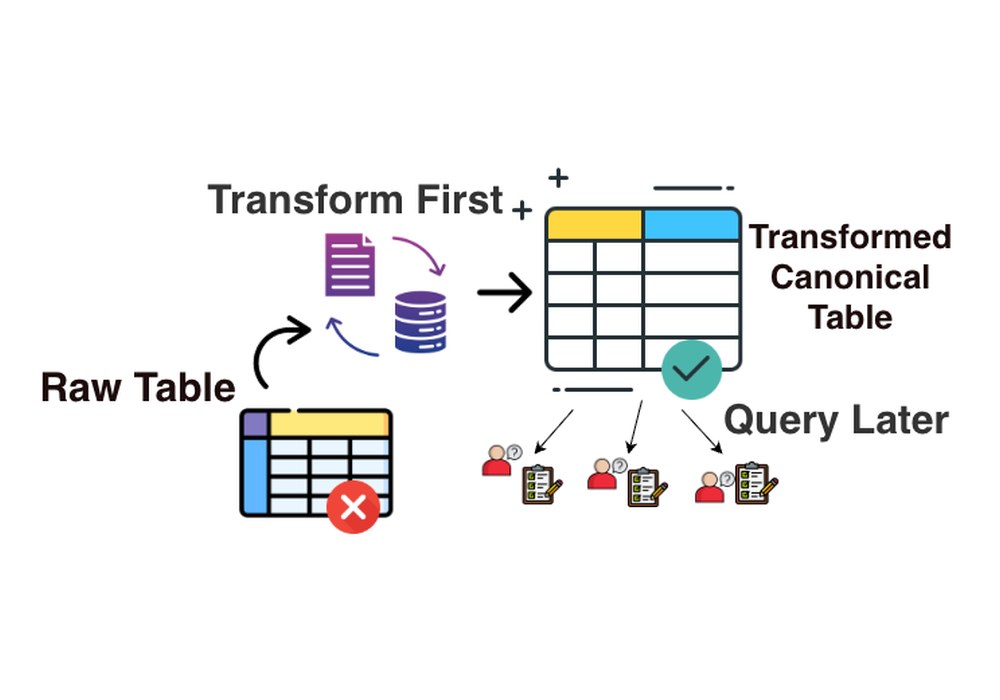
Real-world tables often contain schema inconsistencies, heterogeneous value formats, and implicit relational structures that degrade table reasoning and question answering. Existing approaches address these issues at query time, repeating normalization and restructuring for every new question and producing representations that do not generalize to unseen queries. We introduce QuIeTT, a transform-first, query-later framework that converts each raw table into a single SQL-ready canonical representation before any evaluation query is observed, under three constraints: no evaluation query access, information preservation, and single-table reuse. QuIeTT operates through a three-stage pipeline: issue probing, where synthetic queries surface structural deficiencies such as ambiguous schemas and heterogeneous formats; plan generation; and structured execution. Experiments on four benchmarks across five model families show consistent improvements over strong baselines in both direct prompting and agentic reasoning paradigms, with particularly strong gains on a manually annotated challenge set of structurally diverse unseen questions.
- Prasham Titiya, Leon Engländer*, Gaurav Najpande*, Tampu Ravi Kumar*, Iryna Gurevych, and Vivek GuptaIn Proceedings of EMNLP (Main Conference), 2026
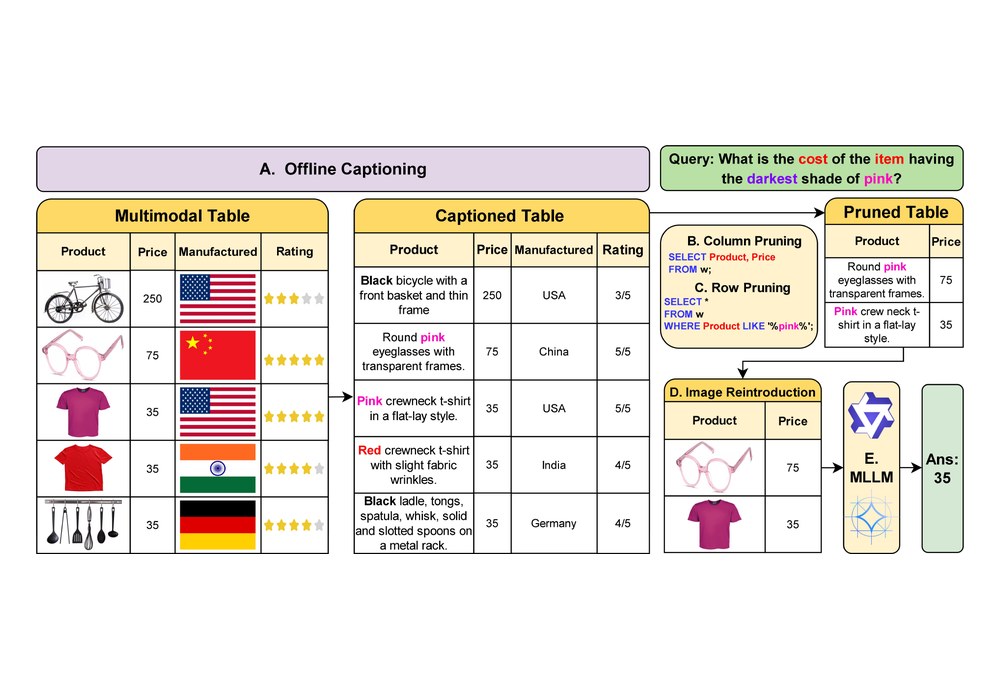
Multimodal Large Language Models struggle with tabular reasoning on tables containing images as cells owing to their limited memory and the distractions posed by the surrounding irrelevant visual elements. Existing context-reduction methods reduce context size but degrade reasoning accuracy: text-only pruning neglects visual cells, token-level pruning discards valuable information, and retrieval cannot understand table structure. We propose CAPTR: Caption-based Context Pruning for Tabular Reasoning, a two-stage framework that uses image captions as a lightweight textual proxy to prune non-pertinent rows and columns and then restores images for reasoning. CAPTR can reduce the context length by 80% while achieving up to 8% accuracy improvement against competitive baselines. By analyzing the error cases, we find that entity confusion contributes to the majority of the remaining errors. CAPTR is the first multimodal context-reduction method to improve performance on multimodal tabular reasoning.
- AIKN Iyengar*, Tampu Ravi Kumar*, Manan Suri, Raviteja Bommireddy, Dinesh Manocha, Puneet Mathur*, and Vivek Gupta*In Proceedings of ACL: System Demonstrations, 2026
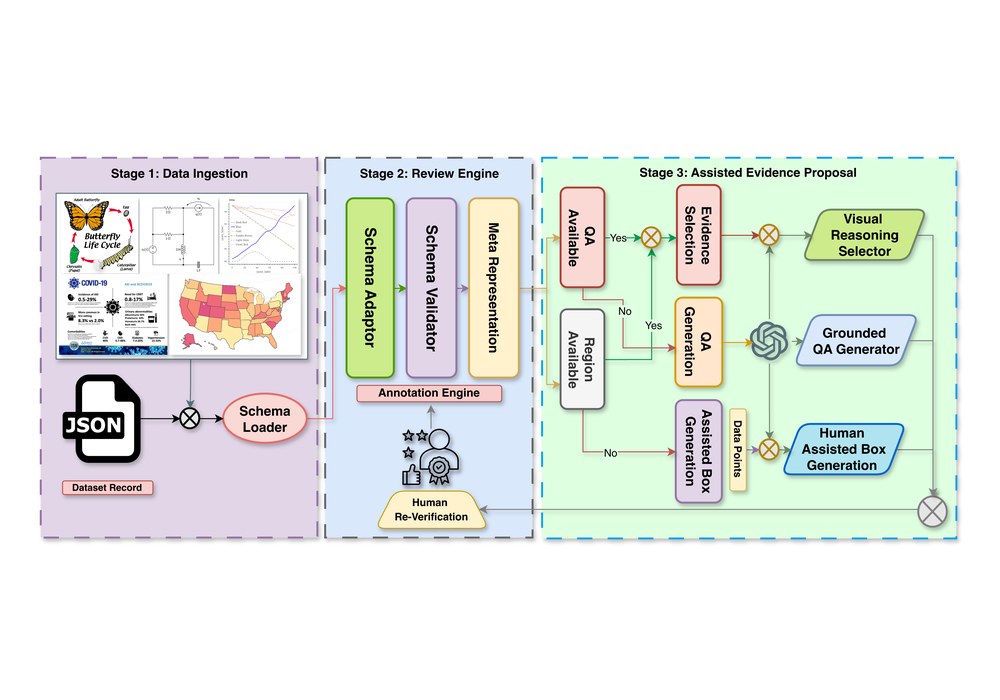
Diagram question answering (Diagram QA) requires reasoning-level attribution that links each question-answer pair to all visual regions needed to derive the answer, rather than only the region containing the final response. Creating such structured evidence across diagrams, charts, maps, circuits, and infographics is time-consuming, and existing annotation tools tightly couple their interfaces to dataset-specific formats. We present DIAGRAMS, a lightweight, schema-driven review framework that decouples interface logic from dataset-specific JSON structures through an internal meta-schema and dataset adapters. Given an image and QA pair with optional candidate regions, the system performs QA-conditioned evidence selection and proposes the regions required for reasoning. When QA pairs or candidate regions are missing, it generates them and supports human verification and refinement. Across six Diagram QA datasets, model-suggested evidence achieves 85.39% precision and 75.30% recall against reviewer-final selections (micro-averaged). These results indicate that the review-first framework reduces manual region creation while maintaining high agreement with final reasoning-level attributions. We release a public demo and installable package to support dataset auditing, grounded supervision creation, and grounded evaluation.
- Tampu Ravi Kumar, Ayoub Daliri, and Vivek GuptaIn Submitted to IEEE International Conference on Acoustics, Speech and Signal Processing (ICASSP 2027),Under review
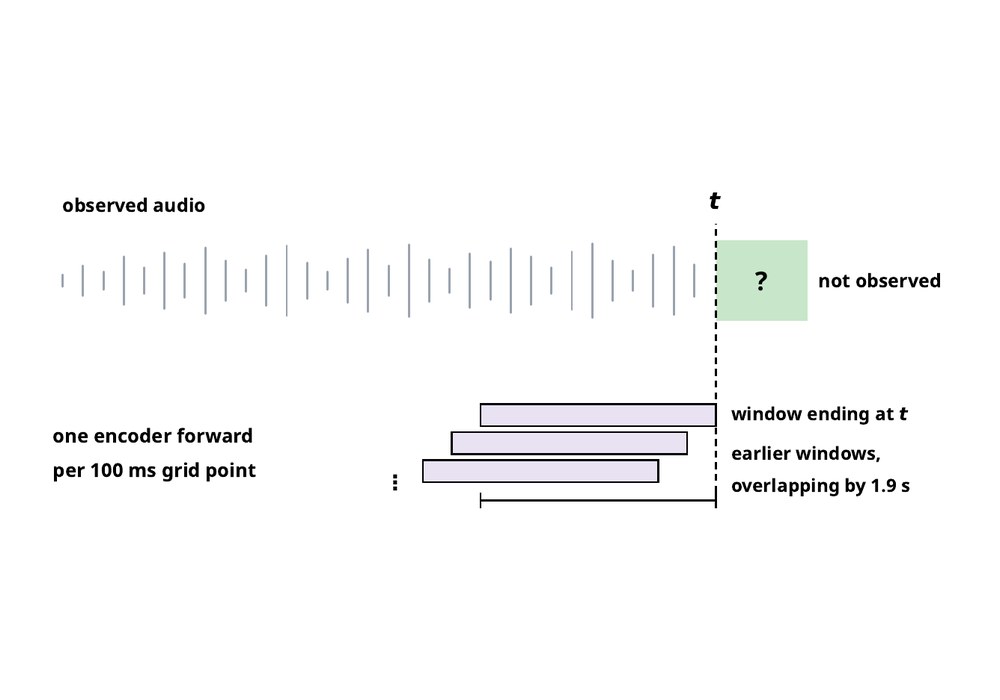
Automatic stuttering systems primarily detect dysfluencies after they have occurred, limiting their use for anticipatory intervention. We address this gap by formulating stuttering prediction as continuous causal time-to-event forecasting, where a model estimates the risk of an upcoming stuttering onset every 100 ms using only preceding speech. To support this task, we augment FluencyBank Timestamped for 36 speakers with manually reviewed repetitions, prolongations, and blocks, yielding 2,872 forecasting events. We then model the temporal evolution of frozen Whisper-large-v3 speech representations using a compact causal Conformer with 3.67M trainable parameters. The proposed approach achieves an AUROC of 0.63. Temporal analysis further shows that explicitly modeling preceding speech states outperforms simply increasing the static acoustic window, while a discrete-time survival formulation provides coherent forecasts from 300 ms to 1.5 s using a single model. These results provide initial evidence that stuttering onset is preceded by measurable temporal information in speech and establish a framework for future anticipatory stuttering systems.